- PlateDiary
- Guides
- What to order: Filipino restaurant
Guide · Filipino food
What to order at a Filipino restaurant, with rice in the middle.
A Filipino menu can look like a list of strangers: sinigang, kare-kare, lechon kawali, pancit. The trick is that nobody orders one plate each. Dishes go in the middle, rice goes on every plate, and the little bowls of vinegar and soy sauce are yours to mix. Here is what to order, for two and for a group, and how the table works.
Free on iPhone and Android. No account, and it works with no signal.

In short
At a Filipino restaurant, order to share. For two: one braise or soup (chicken adobo or sinigang), one crispy dish (lechon kawali or lumpia shanghai), a noodle or vegetable dish, and rice each; halo-halo for dessert. For a group, add kare-kare, crispy pata or sisig, a pancit and a grill plate such as chicken inasal. Eat with a spoon and fork, take from shared dishes with the serving spoon, and mix your own sawsawan (dipping sauce) from vinegar, soy sauce, calamansi and chilli.
Checked
For two
A first-timer order for two.
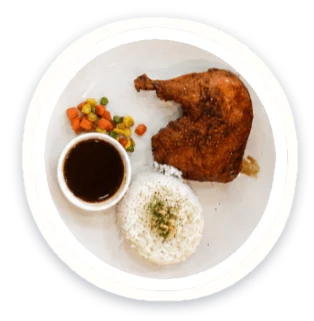
- One soup or braise: chicken adobo if you want something familiar, sinigang if you want the sour, tamarind-sharp side of Filipino food.
- One crispy dish: lechon kawali or a plate of lumpia shanghai.
- One noodle or vegetable: pancit canton or pancit bihon.
- Rice each: plain, or garlic rice.
- Dessert to share: halo-halo, two spoons.
For a group
For four to six people.
- Keep the order for two, then add:
- A showpiece: kare-kare with its bagoong, or crispy pata.
- A sizzling plate: sisig.
- From the grill: chicken inasal or pork barbecue skewers.
- A second soup if it is cold or rainy: bulalo.
- Two desserts: leche flan and turon alongside the halo-halo.
Cheat sheet
Twenty Filipino dishes, in one line each.
| What it is | |
|---|---|
| Adobo | Chicken or pork braised in vinegar, soy sauce, garlic and bay leaf |
| Sinigang | A sour soup, usually soured with tamarind, with pork, prawns or fish and vegetables |
| Kare-kare | Oxtail and vegetables in a thick peanut sauce, served with bagoong (shrimp paste) |
| Lechon kawali | Pork belly boiled, then deep-fried until the skin crackles |
| Crispy pata | A whole pork knuckle, deep-fried; a group dish |
| Sisig | Chopped pork, often from the head, with onion, chilli and calamansi on a sizzling plate |
| Lumpia shanghai | Thin fried spring rolls with a ground pork filling |
| Pancit canton | Stir-fried egg noodles with vegetables and meat |
| Pancit bihon | Stir-fried thin rice noodles |
| Pancit palabok | Rice noodles under an orange shrimp sauce, egg and crushed pork crackling |
| Chicken inasal | Grilled chicken marinated in calamansi, vinegar and annatto, from Bacolod |
| Pork barbecue | Sweet, glazed pork skewers |
| Kaldereta | A rich tomato-based beef stew |
| Bulalo | Beef shank and bone-marrow soup |
| Arroz caldo | Ginger rice porridge with chicken |
| Tapsilog | Cured beef with garlic rice and a fried egg — the silog breakfast plate |
| Halo-halo | Shaved ice and milk over sweet beans, fruit and jellies, often with ube and leche flan |
| Leche flan | A dense caramel custard |
| Turon | Banana and jackfruit in a crisp, caramelised wrapper |
| Bibingka | Rice cake baked in banana leaf, a Christmas-season favourite |
At the table
How the Filipino table works.
- Spoon and fork. Rice dishes are eaten with a spoon and fork; knives are often not set out, because the edge of the spoon does the cutting.
- Serving spoons for shared dishes. Take a little from the middle onto your rice with the serving spoon, not your own.
- Mix your own sawsawan. Small bowls of vinegar, soy sauce, calamansi and fish sauce (patis) are put together to taste at the table. Soy sauce with calamansi and chilli is toyomansi; soy, vinegar and chilli goes with grilled meat.
- Kamayan means eating by hand. At a kamayan or boodle fight, food is laid out on banana leaves down the table and everyone eats straight off the leaves, no plates or cutlery.
- Unli rice is a thing. Some chains, such as Mang Inasal, offer unlimited rice refills with a meal.
Keep it
Six dishes, one photo.
A Filipino table is a dozen plates and a few little sauce bowls — beautiful for about a minute. Take one photo then. PlateDiary cuts each dish into its own save, so the kare-kare and the lumpia each get their name and stars, grouped into one moment at that restaurant. Add the people at the table as companions, and their pages remember who ordered the crispy pata.
Planning a trip? See what to eat in the Philippines and our Pampanga food trip.
Sources
Where the facts come from
Questions
Questions people ask.
What should I order at a Filipino restaurant for the first time?
Chicken adobo or sinigang, lechon kawali or lumpia shanghai, a pancit and rice for each person, then halo-halo to share. For a group, add kare-kare, sisig and grilled chicken inasal.
What is the most popular Filipino dish?
Adobo — meat braised in vinegar, soy sauce, garlic and bay leaf — is the dish most often called the national dish. Sinigang, lechon and sisig are close behind.
Why do Filipinos eat with a spoon and fork?
Most meals are rice with saucy dishes, and a spoon handles rice and sauce better than a fork alone. The edge of the spoon cuts tender meat, so a knife is rarely needed.
What is a Filipino boodle fight?
A meal laid out on banana leaves along the table — rice, grilled meat, seafood and vegetables — eaten by hand with no plates or cutlery. Eating by hand is called kamayan.
Keep reading
More from the diary
Guides
Filipino food to try
Filipino food to try on a first trip: adobo, sinigang, lechon, sisig, halo-halo and the regional dishes worth a flight, plus how a Filipino meal works.
Open →Calories
Filipino food
Rough calories for Filipino restaurant plates — adobo, inasal, lechon kawali, pancit, silog and halo-halo — with and without rice, and what makes them heavier.
Open →Guides
Pampanga food trip
A Pampanga food trip up the NLEX: sisig where it was popularised, tokwa’t baboy, heirloom Kapampangan cooking and halo-halo, town by town in driving order.
Open →Guides
What to order: Malaysian restaurant
What to order at a Malaysian restaurant: an order for two and for a group, 20 dishes from nasi lemak to bak kut teh, kopitiam drink codes, and table manners.
Open →Made for
Filipinos abroad
For Filipinos abroad: how to find Filipino food in a new city, and how to keep the sinigang, the halo-halo and the bakery that taste like home on one map.
Open →
Features
Companions
A round table of the people you share meals with, and a page for each: where it started, your usual together, your spots and every table you’ve shared.
Open →