- PlateDiary
- Guides
- How to order at a hawker centre
Guide · Singapore
How to order at a hawker centre, stall by stall.
You have found a seat, you have joined the right queue, and now the uncle at the counter is looking at you. Every hawker stall asks its own quick questions, and the regulars answer in three words. This is the phrasebook: what each kind of stall will ask, what to say back, and a first order you can read straight off your phone.
Free on iPhone and Android. No account, and it works with no signal.
In short
At a Singapore hawker centre, order and pay stall by stall. The first question is usually whether you are eating here — say “here” or “dabao” for takeaway. At a chicken rice stall, say roasted or white and which cut; at a noodle stall, pick the noodle, dry or soup, and chilli or not; at economy rice, point at the dishes you want and ask for curry or gravy over the rice. Remember your table number and carry some cash.
Checked
The phrasebook
What they ask, and what to say.
| They ask | You say | |
|---|---|---|
| Any stall | “Eat here?” / “Having here?” | “Here” — or “dabao” (also “tapao”) for takeaway |
| Chicken rice | “Roasted or white?” | “White” (poached) or “roasted”; some stalls also do soya sauce chicken |
| Chicken rice | “Which part?” | “Breast,” “thigh” or “drumstick” |
| Noodles | “Which noodle?” | “Mee pok,” “mee kia,” “kway teow” or “bee hoon” |
| Noodles | “Dry or soup?” | “Dry” or “soup” |
| Noodles (dry) | “Chilli?” | “Chilli” or “no chilli” |
| Economy rice | “What you want?” | Point: “this, this and this” — then “curry on top” or “gravy” |
| Zi char | “Small, medium, large?” | “Small” is often enough for two |
| Many stalls | “Table number?” | The number on your table — note it before you queue |
Stall one
Ordering chicken rice.
Not sure what makes it special? See Hainanese chicken rice for the dish itself.
- The default is white — poached chicken. Roasted is the other choice, and a mix often costs a little more.
- Name the cut. Breast, thigh or drumstick; drumstick can cost extra.
- One person, or a share? A single plate comes with rice. Half or whole chicken is meat only, so order rice for each person separately.
- Sauces are self-serve. Chilli and minced garlic usually sit by the counter; help yourself while you wait.
- Your order, out loud: “One chicken rice, white, drumstick, eat here.”
Stall two
Ordering noodles: four choices, in order.
Taking dry noodles away? Ask for the soup — some stalls leave it out of a takeaway. Your order: “Mee pok, dry, chilli, small, dabao.”
- The dishBak chor mee (minced pork noodles), fishball noodles, wonton mee — whatever is on the sign.
- The noodleMee pok is flat egg noodles, mee kia thin egg noodles, kway teow flat rice noodles, bee hoon thin rice vermicelli.
- Dry or soupDry noodles are tossed in a sauce of chilli, oil and vinegar with the soup on the side. In Hokkien, dry is “tah” and soup is “terng.”
- Chilli or not, and the sizeSay chilli or no chilli for dry noodles. Many noodle stalls sell two or three sizes; point at the size on the sign or ask for small, medium or large.
Stall three
Ordering economy rice (cai fan).
Economy rice is a stall of ready-cooked dishes in trays: you choose a few and they go over a plate of rice.
- Say “eat” or “takeaway” first, before the rice is scooped, so it goes on the right plate or box.
- Point and say “this.” Pick dishes from the trays; they all go on one plate of rice unless you ask for them separately.
- It is priced by the combination — vegetables cost less than meat, and fish or cutlets cost more. Ask the price before you add a fifth dish.
- Ask for curry or braised gravy over the rice. It is usually free, and it makes the plate.
- Want more rice? Ask for “a little more rice” — extra plain rice is often free.
Stall four
Ordering at a zi char stall.
Zi char (also tze char) stalls cook home-style Chinese dishes to order, for the table to share — sambal kangkong, cereal prawns, sweet and sour pork, sometimes chilli crab. Pick a size for each dish; even a small can be family-sized, so two people do well with two or three smalls and rice. Give your table number, sit down, and the dishes come out as they are cooked.
Before you queue
Paying, halal signs and drinks.
- Carry cash. More than 11,500 hawkers had taken up the national SGQR code by late 2024, and PayNow and PayLah are widely accepted — but cards often aren’t, and some hawkers still prefer cash.
- Halal: look for the MUIS halal certificate at the stall. A “no pork, no lard” sign is not the same as certification; HalalSG’s advice is “check, ask, decide.” Many coffee shops have separate halal stalls.
- Drinks come from their own stall. For the kopi and teh words, see our hawker food guide. A takeaway drink in a plastic bag often skips the container charge.
- Check the days. Each stall sets its own hours and rest days — even famous ones close one day a week.
Copy this
Your first hawker order, written out.
- ☐ Table number: ___ (and tissues on the seat)
- ☐ “One chicken rice, roasted, thigh, eat here.”
- ☐ “Mee pok, dry, chilli, small.”
- ☐ “Kopi peng.” (Iced coffee with condensed milk.)
- ☐ Something you have never heard of, from the stall with the longest queue: ___
- ☐ Tray returned. (It’s the law.)
Keep it
Four stalls, one tray, one photo.
A hawker lunch is plates from four different stalls on one table. Snap it once and PlateDiary cuts every plate out into its own save, filed under that hawker centre and that lunch. Write the stall number in the note, give the stall a stamp in Stamps — a street stall counts — and its page remembers what you ordered there. Prices stay in Singapore dollars, exactly as you paid.
Sources
Where the facts come from
- How to order food in a hawker centre in Singapore — Trevallog
- dabao — Wiktionary
- Mee pok — Wikipedia
- How to eat cai fan in Singapore — Nomad eSIM
- How to order economical rice — OpenRice Singapore
- Hawker centres in Singapore — Nomad eSIM
- Kok Sen Restaurant — Migrationology
- Tze char — Wikipedia
- Hawkers and digital payments (The Straits Times) — Asia News Network
- HalalSG’s guide to halal food — muslim.sg
- Kopitiam secrets — TheSmartLocal
Questions
Questions people ask.
What does dabao mean?
Takeaway. “Dabao” (also “tapao”) comes from the Chinese for “to pack,” and it is how most people in Singapore ask for food to go.
How do you order chicken rice in Singapore?
Say white (poached) or roasted, which cut — breast, thigh or drumstick — and whether you are eating here or taking it away. Chilli and garlic are usually self-serve.
What is mee pok?
Flat yellow egg noodles, often served dry — tossed in chilli, oil and vinegar — with minced pork or fishballs and a bowl of soup on the side.
Do hawker centres accept cards?
Often not. Many stalls take the SGQR code with PayNow or PayLah, but cards are less common and some stalls are cash only, so carry small notes.
How do you order economy rice?
Tell them eat-in or takeaway, point at the dishes you want, and ask for curry or gravy on the rice. The price depends on the combination you pick.
Keep reading
More from the diary
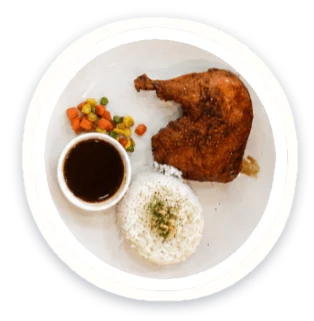
Guides
Singapore hawker food
Singapore hawker food for first-timers: how a hawker centre works, saving seats, ordering kopi, returning trays, and the dishes to try first.
Open →Guides
Singapore food bucket list
A Singapore food bucket list: chilli crab, chicken rice, the Michelin-starred bak chor mee, Katong laksa, kaya toast, a Singapore Sling, satay street and more.
Open →Guides
Chinatown Singapore food guide
Eat through Singapore’s Chinatown: chicken rice and oyster cake at Maxwell, claypot rice at Chinatown Complex, egg tarts and bak kwa to take away.
Open →
Calories
Calories in Hainanese chicken rice
Hainanese chicken rice: about 600 calories per restaurant serving (usually 500–800). About 159 per 100 g. What changes it, lighter swaps and sources.
Open →Calories
Malaysian & Singaporean food
Rough calories for hawker favourites — nasi lemak, Hainanese chicken rice, laksa and char kway teow — and how coconut, lard and gravy change the plate.
Open →
Guides
Old Airport Road Food Centre
What to eat at Old Airport Road Food Centre in Singapore: three new Bib Gourmand stalls, lor mee, rojak, prawn noodles and banana fritters, in order.
Open →